Mineral testing plays an important role in mining exploration, ore evaluation, and mineral processing. Whether a laboratory determines gold content, measures copper concentration, or identifies valuable elements in complex ores, reliable analytical results are essential for informed decisions. However, the accuracy of mineral testing does not depend entirely on the analytical instrument. The quality of the original sample and its preparation before testing are equally important.
Mineral ores are naturally heterogeneous materials containing different minerals, particle sizes, and chemical compositions. If samples are not properly collected, crushed, ground, and homogenized, the final portion submitted for analysis may not represent the original ore. Even advanced analytical instruments cannot correct errors introduced during these preparation stages.
Understanding why sample preparation determines the accuracy of mineral testing helps laboratories reduce analytical errors, improve reproducibility, and obtain more reliable mineral composition data.
1. Why Is Sample Preparation Important in Mineral Testing?
Mineral sample preparation converts collected ore samples into representative materials suitable for laboratory analysis. It generally involves drying, crushing, sample reduction, grinding, homogenization, and sometimes chemical treatment.
The main objective is to ensure that the small portion used for testing accurately represents the original bulk material. This is particularly important when analyzing ores containing unevenly distributed valuable minerals, such as gold, copper, and tungsten.
Poor sample preparation can introduce several problems:
- Sampling bias: The prepared portion may contain different mineral concentrations from the original sample.
- Uneven particle size: Coarse particles can create inconsistencies between analytical portions.
- Contamination: Worn crushing or grinding components may introduce unwanted elements.
- Material loss: Fine particles may escape during crushing, grinding, or sample transfer.
- Moisture changes: Improper drying and storage may affect sample mass and chemical stability.
Analytical precision does not always guarantee accuracy. Repeated measurements of an unrepresentative sample may produce similar results.
2. How Does Each Sample Preparation Step Affect Testing Accuracy?
Every preparation stage contributes to the quality of the final analytical sample. Errors introduced early in the process can affect all subsequent operations.
2.1 Sample Collection and Drying
Representative sampling underpins reliable mineral testing. Collect Samples from appropriate locations and intervals to reflect the characteristics of the ore body or processing material. Grab sampling, channel sampling, and drill core sampling are common approaches depending on the application.
After collection, drying may be necessary to remove excess moisture and improve crushing and grinding efficiency. However, drying conditions must match the mineral characteristics. Excessive temperatures can cause oxidation, dehydration, or changes in moisture-sensitive materials.
2.2 Sample Crushing and Size Reduction
Crushing reduces large ore fragments into smaller particles, making subsequent sample division and grinding more manageable. Laboratory jaw crushers are commonly used for primary size reduction because they can process hard and medium-hard mineral materials.
The important operating factors include:
- Maximum feed particle size.
- Discharge opening and target particle size.
- Ore hardness and abrasiveness.
- Crushing capacity and material recovery.
- Wear resistance of crushing components.
Incomplete crushing may leave large particles containing unevenly distributed minerals. This can increase segregation during sample reduction and affect the representativeness of the final portion.
2.3 Sample Splitting and Reduction
After crushing, the sample usually needs to be reduced to a smaller quantity for laboratory analysis. This stage is particularly sensitive because valuable minerals may not be evenly distributed throughout the material.
Using a riffle splitter or rotary sample divider helps obtain representative portions when operated correctly. Randomly removing handfuls of material or dividing samples without controlling particle segregation can introduce significant sampling errors.
Laboratories should retain sufficient material for duplicate testing, quality control, and future verification.
2.4 Fine Grinding and Homogenization
Grinding reduces particle size further and helps produce a more uniform sample. Depending on the required fineness and sample characteristics, laboratories may use disc mills, ring pulverizers, vibratory disc mills, or ball mills.
Fine grinding is especially important for techniques such as XRF, where particle-size differences and mineralogical effects can influence analytical measurements.
However, finer grinding does not automatically guarantee better results. Excessive grinding may increase equipment wear, contamination, and processing costs.
Practical considerations include:
- Selecting grinding equipment according to ore hardness.
- Controlling grinding time and operating speed.
- Choosing suitable grinding components.
- Verifying the final particle-size distribution.
- Ensuring effective mixing before final sample testing.
The objective is not simply to produce the finest powder possible, but to achieve the particle size and homogeneity required by the analytical method.
3. Common Sample Preparation Problems That Reduce Testing Accuracy
Several preparation problems can directly affect reported mineral concentrations.
Equipment Contamination
Crushing jaws, grinding discs, and pulverizing components gradually wear during operation. Depending on their composition, they may introduce iron, chromium, tungsten, or other unwanted elements into the sample.
For example, when testing tungsten-bearing ores, tungsten carbide grinding components may introduce additional tungsten contamination. Laboratories should therefore select contact materials according to the elements being analyzed.
Inadequate Grinding and Uneven Particle Distribution
If a sample contains coarse and fine particles with different mineral compositions, the analytical portion may not reflect the original material. This can produce inconsistent results between duplicate samples.
Improper Storage and Material Loss
Exposure to moisture, air, and unsuitable storage conditions may alter sensitive samples. In addition, dust loss during grinding and material transfer can change the composition of the remaining sample.
To minimize these problems, laboratories should establish equipment cleaning procedures, use suitable sample containers, control dust collection, and maintain accurate sample identification records.
4. How Sample Preparation Affects Different Mineral Testing Methods
Different analytical techniques require different preparation procedures. Understanding these requirements helps laboratories avoid applying unsuitable preparation methods.
- XRF analysis: Usually requires a sufficiently fine and homogeneous powder for pressed pellets or fused beads. Particle size and mineralogical effects can influence measurement accuracy.
- ICP-OES and ICP-MS: Generally require suitable sample dissolution through acid digestion or fusion. Incomplete digestion may result in low elemental recovery.
- Fire assay: Requires representative sampling, appropriate pulverization, and careful mixing to improve the reliability of precious-metal analysis.
- Mineralogical analysis: May require polished sections, thin sections, or particle mounts. Excessive grinding can destroy important particle characteristics and mineral relationships.
For this reason, establish preparation procedures according to the target elements, mineral characteristics, and analytical method rather than using one standard procedure for every sample.
5. How to Choose the Right Mineral Sample Preparation Equipment
Selecting suitable laboratory equipment is essential for preparation consistency and minimizing contamination.
When evaluating equipment, laboratories should consider:
Ore hardness and abrasiveness: Hard, abrasive ores require crushers and grinding components with suitable mechanical strength and wear resistance.
- Required particle size: Jaw crushers are suitable for primary crushing, while disc mills and pulverizers are commonly used for fine grinding.
- Contamination requirements: Select Grinding materials according to the elements being analyzed. Stainless steel, tungsten carbide, zirconium oxide, and agate each have different advantages and potential contamination risks.
- Processing capacity: Equipment capacity should match the laboratory’s sample volume and daily workload.
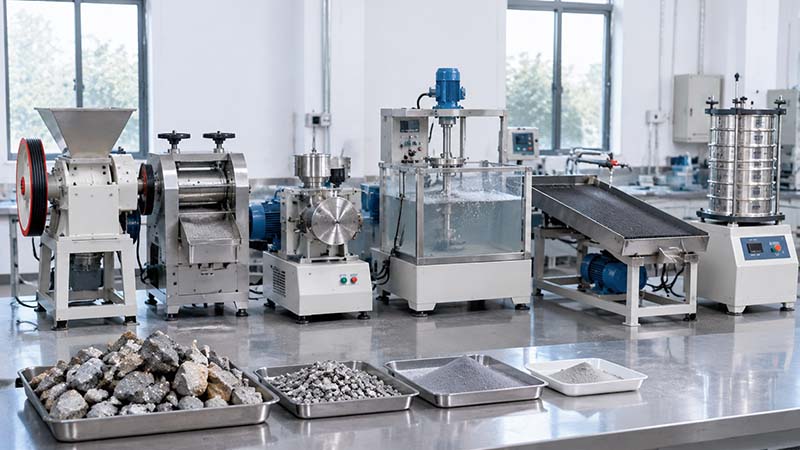
A typical mineral sample preparation workflow may include:
- Sample receiving and drying.
- Primary crushing using a laboratory jaw crusher.
- Sample reduction using a riffle splitter.
- Fine grinding using a disc mill or pulverizer.
- Homogenization and particle-size verification.
- Final sample division and packaging.
Combining suitable equipment into an integrated workflow improves processing efficiency and maintains consistent preparation conditions.
6. Quality Control Practices for Reliable Mineral Testing
Systematic quality control supports proper equipment and preparation procedures. Laboratories can use several methods to identify errors.
- Blanks: Help identify contamination introduced by equipment, reagents, or sample handling.
- Duplicate samples: Evaluate preparation and analytical repeatability.
- Certified reference materials (CRMs): Compare measured results with established reference values to identify analytical bias.
- Equipment inspection: Regularly check crushing jaws, grinding discs, and other components for wear.
- Standard operating procedures: Document sample mass, drying conditions, crushing settings, grinding parameters, and cleaning requirements.
Following relevant laboratory standards, including ISO/IEC 17025, also supports consistent testing procedures, traceability, and measurement reliability.
Conclusion
Sample preparation is much more than a preliminary laboratory operation. It directly influences whether analytical results accurately represent the original mineral material. From representative sampling and controlled crushing to fine grinding, homogenization, and contamination prevention, every stage contributes to testing’s reliability.
For mining laboratories, investing in suitable sample preparation equipment and standardized operating procedures can reduce preparation errors, improve reproducibility, and support more dependable analytical decisions. Ultimately, accurate mineral testing starts long before the sample reaches the analytical instrument.
JXSC lab mineral processing equipment manufacturer has more than 38 years of experience in mining processing. We provide various lab mining equipment including gravity-separating equipment for processing minerals such as gold, tin, tungsten, lead, zinc, tantalum, niobium, iron, manganese, silver, titanium-iron, etc. Lab machines include laboratory jaw crusher, hammer crusher, roller crusher, grinding equipment, lab gravity separator, screening, washing equipment, etc. Welcome to consult!