Wolframite is one of the most important tungsten-bearing minerals, but recovering tungsten efficiently is not simply a matter of selecting a gravity concentrator or magnetic separator. Ore texture, liberation size, associated minerals, and the distribution of tungsten in different particle-size fractions can significantly change the ideal beneficiation route.
For this reason, a reliable wolframite processing strategy should begin with laboratory testing and mineral characterization. The test results can then guide the selection of the beneficiation method, equipment, grinding conditions, and final flowsheet. This approach reduces unnecessary equipment investment while improving the likelihood of achieving the required tungsten recovery and concentrate grade.
This guide explains the relationship among wolframite beneficiation equipment, beneficiation methods, and lab testing, with a practical focus on developing an efficient processing solution.
Understanding Wolframite Before Beneficiation
Wolframite represents a mineral series between ferberite and hübnerite, with iron and manganese occupying the metal position. Its relatively high density compared with common gangue minerals such as quartz makes gravity concentration particularly attractive for many deposits.
However, the physical properties of an ore are only part of the picture. Two wolframite deposits with similar head grades may behave very differently during processing because their tungsten minerals can occur as coarse liberated grains, fine disseminations, or composite particles locked with gangue.
Before selecting equipment, evaluate:
- Head WO₃ grade and tungsten distribution
- Mineral composition and associated gangue
- Wolframite grain size and liberation characteristics
- Particle-size distribution
- Slime and clay content
- Presence of sulfide minerals
- Magnetic properties
- Potentially valuable associated minerals
Practical recommendation: Do not select the complete equipment list from the assay grade. Mineralogical information and beneficiation test results are much more useful for determining the actual process.
Why Laboratory Testing Should Come First?
Once laboratory results identify the appropriate separation methods, equipment selection becomes much more straightforward.
Crushing and Grinding Equipment
Jaw crushers are commonly used for primary size reduction, while secondary crushing and screening can prepare a controlled feed for grinding. Grinding equipment should be selected according to the liberation requirement established by testing.
A key principle is to avoid unnecessary over-grinding. Excessive grinding can convert recoverable wolframite into fine particles that are more difficult to separate.
Gravity Separation Equipment
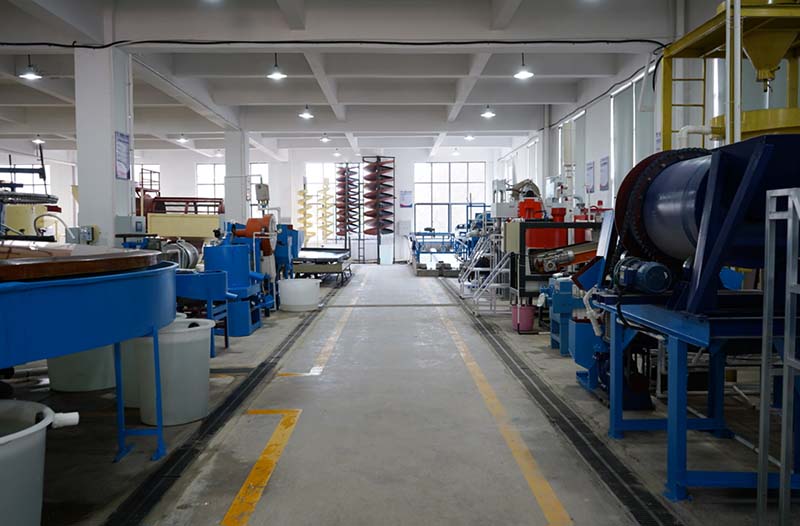
The appropriate gravity equipment depends strongly on feed size and duty:
Equipment
- Jig Separator
- Roughing coarse/medium ore
- Feed-size control
- Shaking table
- Cleaning and fine gravity recovery
- Capacity and water control
- Spiral chute
- Large-volume fine separation
- Fine-slime limitations
- Centrifugal concentrator
Fine heavy-mineral recovery
Operating optimization
The final plant may combine two or more of these machines.
Magnetic and Flotation Equipment
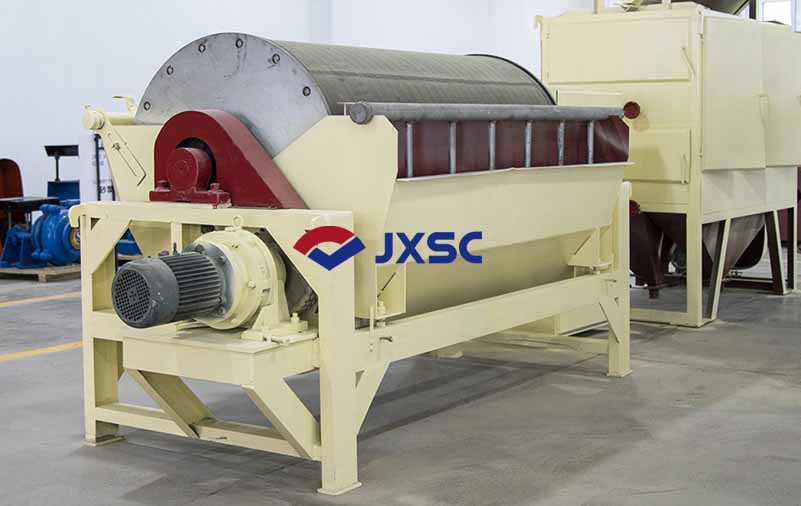
Wet magnetic separators can be incorporated when magnetic testing shows a clear beneficiation advantage. For flotation circuits, conditioning tanks, flotation machines, reagent systems, and dewatering equipment must be considered together.
Equipment selection should also account for:
- Required capacity
- Feed particle size
- Recovery target
- Concentrate specification
- Water consumption
- Power consumption
- Maintenance requirements
- Available plant space
Recommended Laboratory Testing Sequence
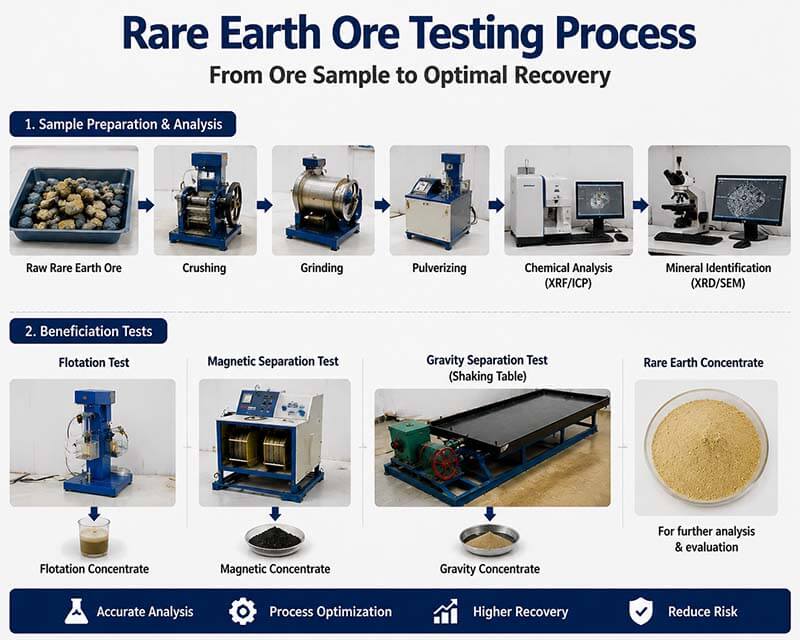
Representative sample preparation – ensure the test sample reflects the actual ore.
- Head sample analysis – determine WO₃ grade and major associated elements.
- Mineralogical examination – identify tungsten-bearing minerals and their associations.
- Screening analysis – determine how tungsten is distributed by particle size.
- Crushing and grinding tests – establish a suitable liberation size.
- Gravity tests – evaluate jigging, tabling, or centrifugal concentration.
- Magnetic or flotation tests – investigate difficult fine or contaminated fractions.
- Cleaning and locked-cycle testing – confirm whether the proposed flowsheet remains effective with recycled streams.
The objective is to transform test data into a practical plant flowsheet rather than produce an impressive laboratory concentrate.
Choosing the Right Wolframite Beneficiation Method
There is no universal wolframite beneficiation method. The best route depends on the characteristics revealed during testing.
Gravity Separation
Gravity separation is often an excellent starting point where wolframite occurs as relatively coarse, liberated particles. The density contrast between wolframite and lighter gangue allows heavy mineral concentration without large reagent consumption.
Typical equipment includes:
- Mineral jig separator: suitable for coarse and medium-sized material and high-capacity roughing.
- Shaking table: useful for concentration and cleaning of finer heavy minerals.
- Spiral chute: applicable where large volumes of suitable fine material must be treated.
- Centrifugal concentrator: useful when significant fine heavy-mineral recovery is required.
A practical flowsheet may therefore use different gravity machines for different particle-size ranges rather than forcing the entire feed through one separator.
Magnetic Separation
Wolframite can exhibit magnetic response, although the strength varies with mineral composition. Magnetic separation can therefore become useful when laboratory testing demonstrates sufficient contrast between wolframite and unwanted minerals.
It may be considered for:
- Fine wolframite recovery
- Concentrate cleaning
- Treatment of selected gravity products
- Separation from strongly magnetic minerals
- Upgrading difficult fractions
Magnetic field intensity, feed size, slurry density, and separator configuration should be established experimentally rather than selected solely from general equipment specifications.
Flotation
Flotation is generally more specialized than gravity concentration for wolframite. It becomes particularly relevant when very fine material is difficult to recover using conventional gravity equipment or when associated sulfide minerals need to be removed.
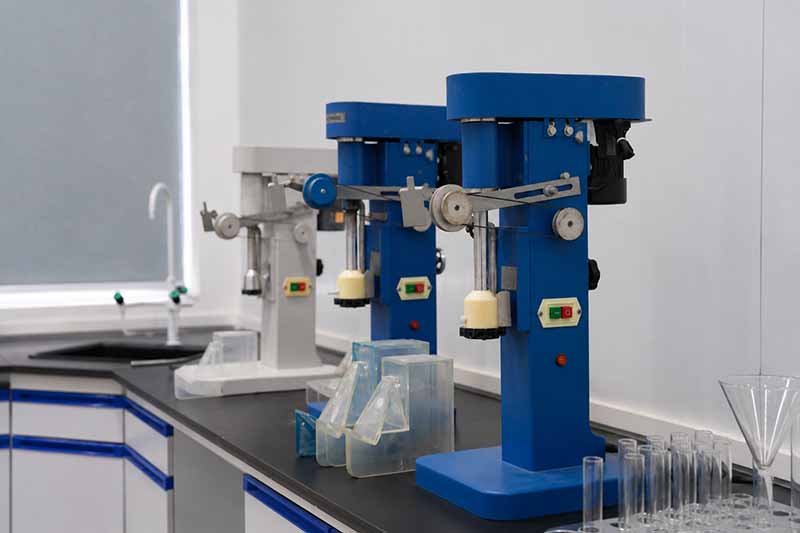
Laboratory flotation testing should investigate:
- Reagent type and dosage
- Pulp pH
- Conditioning time
- Rougher and cleaner stages
- Fine-particle response
- Sulfide removal efficiency
Flotation should be introduced when it solves a demonstrated metallurgical problem, rather than simply making the flowsheet more complicated.
How to Build a Practical Wolframite Flowsheet?
A simple ore may require only crushing, screening, and gravity concentration. A more complex deposit may require several separation stages.
For example:
Coarse liberated ore:
- Crushing → Screening → Jig → Table → Dewatering
Fine-grained ore:
- Crushing → Grinding → Classification → Fine Gravity → Cleaning
Complex ore with fine or magnetic fractions:
- Grinding → Classification → Gravity Concentration → Magnetic Separation → Cleaning
Ore containing significant sulfides:
- Gravity Pre-Concentration → Sulfide Flotation → Tungsten Cleaning
These are starting concepts, not universal recipes. The laboratory results should determine which circuit is justified.
How to Reduce Tungsten Losses?
A high concentrate grade does not necessarily mean the plant is performing well. A circuit can produce excellent concentrate while losing substantial tungsten to tailings.
Operators should regularly investigate:
- WO₃ losses in coarse crushing products
- Tungsten distribution in grinding products
- Classification overflow losses
- Gravity tailings
- Magnetic separation tailings
- Fine-slime losses
- Recycle and middling streams
One of the most valuable diagnostic tools is a size-by-size tungsten balance. If laboratory analysis shows that most lost tungsten is concentrated in a particular fine fraction, adding more crushing capacity will not solve the problem. A targeted fine-recovery test is more appropriate.
From Laboratory Results to Industrial Plant Design
The transition from laboratory testing to plant design should be systematic. First, establish the mineralogical characteristics and liberation behavior. Next, compare separation methods and identify the simplest circuit capable of achieving the required metallurgical performance.
The final decision should consider more than recovery:
- Concentrate WO₃ grade
- Tungsten recovery
- Mass yield
- Capital investment
- Operating cost
- Energy consumption
- Water requirement
- Reagent consumption
- Tailings management
- Equipment reliability
Expert recommendation: The best wolframite processing plant is not necessarily the plant with the most sophisticated equipment. It is the plant that achieves the required recovery and concentrate quality with a flowsheet that is technically stable and economically sustainable.
Conclusion
Successful wolframite beneficiation begins with understanding the ore rather than immediately purchasing equipment. Lab testing establishes the liberation characteristics, tungsten distribution, and response to different separation methods. These results provide the foundation for selecting the right combination of gravity, magnetic, flotation, crushing, grinding, classification, and dewatering equipment.
JXSC lab mineral processing equipment manufacturer has more than 38 years of experience in mining processing. We provide various lab mining equipment including gravity-separating equipment for processing minerals such as gold, tin, tungsten, lead, zinc, tantalum, niobium, iron, manganese, silver, titanium-iron, etc. Lab machines include laboratory jaw crusher, hammer crusher, roller crusher, grinding equipment, lab gravity separator, screening, washing equipment, etc. Welcome to consult!