In modern mining operations, extracting valuable minerals from ore is no longer based only on selecting standard processing equipment. Every ore deposit has unique characteristics. Therefore, conducting a Mineral Ore Beneficiation Test and equipment evaluation is a critical step before building or upgrading a mineral processing plant.
A beneficiation test provides scientific data to determine whether an ore can be economically processed and which separation methods can achieve the best recovery. Without reliable testing, mining companies may face problems such as inappropriate equipment selection, unstable production performance, low recovery rates, and unnecessary investment costs.
From laboratory analysis to industrial-scale production, mineral beneficiation testing is a bridge between ore characteristics and practical processing solutions. A professional testing program can help engineers design an optimized flowsheet, select suitable mineral processing equipment, and predict production performance before large-scale investment.
What Is a Mineral Ore Beneficiation Test?
A Mineral Ore Beneficiation Test is a series of laboratory and pilot-scale experiments performed on ore samples to study their processing method. The main purpose is to identify the most suitable beneficiation method and determine the technical parameters required for plant design.
Because different ores have different mineral structures, there is no universal beneficiation process. For example, two gold deposits may both contain gold, but one may be suitable for gravity concentration, while the other may require flotation or cyanide leaching after testing.
A complete beneficiation test usually aims to answer several important questions:
- What valuable minerals exist in the ore?
- How are valuable minerals distributed?
- At what particle size can minerals be effectively liberated?
- Which beneficiation method provides the highest recovery?
- What equipment configuration can achieve stable operation?
According to mineral processing experts, “A successful beneficiation plant begins with understanding the ore before selecting the equipment.” Testing reduces uncertainty and provides a technical foundation for engineering decisions.
Laboratory-to-Industrial Workflow of Mineral Beneficiation Testing
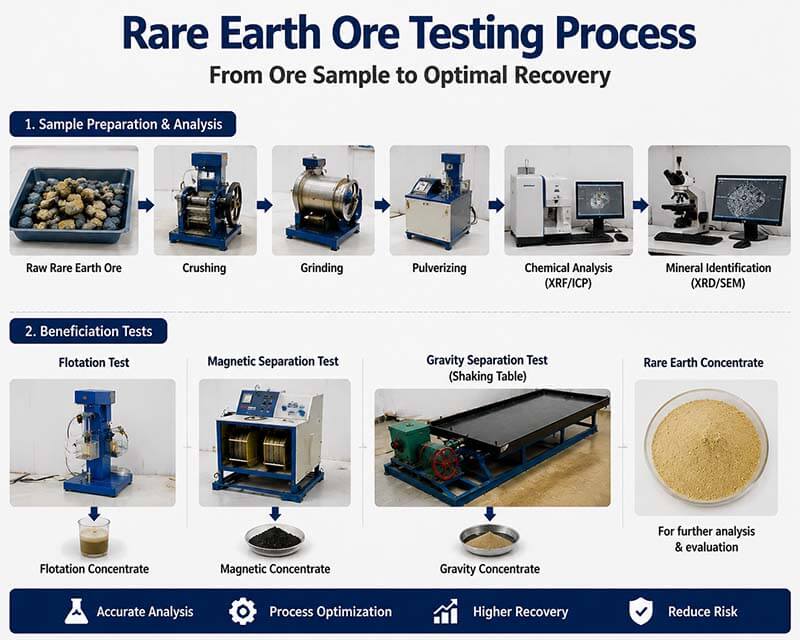
A professional beneficiation project usually follows a step-by-step workflow, starting from ore sampling and ending with industrial process design.
2.1 Ore Sampling and Sample Preparation
The accuracy of a beneficiation test depends heavily on whether the laboratory sample represents the actual ore deposit. An unreliable sample can lead to incorrect conclusions and unsuitable plant design.
The main preparation procedures include:
- Representative ore sampling from the mine site
- Crushing the raw ore to suitable sizes
- Screening and classification
- Grinding tests to determine liberation characteristics
- Sample division for different laboratory experiments
The goal is to reproduce actual mining conditions as closely as possible before testing.
2.2 Mineralogical and Chemical Analysis
Before selecting beneficiation equipment, engineers need to understand the internal ore’s characteristics.
Mineral analysis commonly includes:
Chemical Analysis
Chemical testing determines:
- Valuable element content
- Harmful impurities
- Overall ore grade
Examples:
- Gold content in gold ore
- Iron grade in magnetite ore
- Lithium content in lithium-bearing minerals
Mineralogical Analysis
Advanced technologies such as X-ray diffraction (XRD), SEM-EDS, and microscopic analysis help identify:
Mineral types
- Mineral association
- Mineral liberation degree
- Distribution of valuable minerals
This information determines whether minerals can be separated efficiently by gravity, flotation, magnetic separation, or a combination of methods.
Main Types of Mineral Ore Beneficiation Tests and Equipment
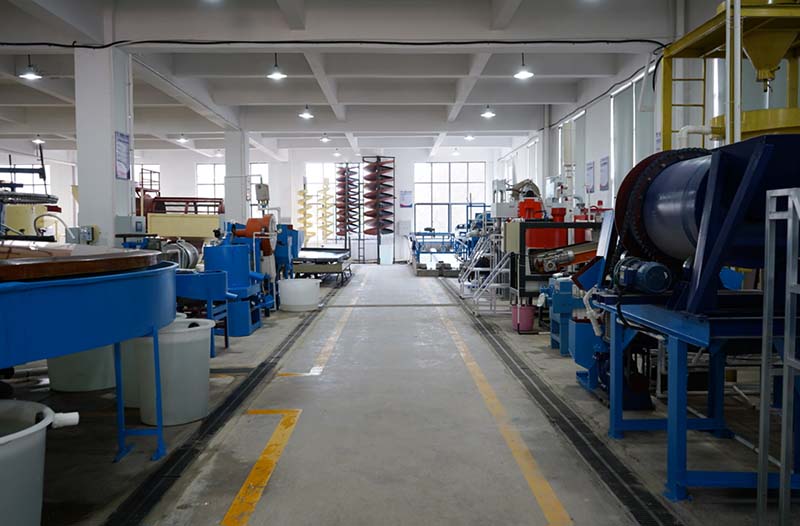
Different ores require different testing methods and corresponding mineral processing equipment. Selecting the correct testing approach is essential for achieving high recovery and economic production.
3.1 Gravity Separation Test and Equipment
Gravity separation uses the difference in mineral density to separate valuable minerals from waste materials. It is commonly used for coarse-grained and high-density minerals.
Typical applications include:
- Gold ore
- Tin ore
- Tungsten ore
- Diamond-bearing ore
Gravity separation tests evaluate:
- Particle size influence
- Concentrate grade
- Recovery rate
- Separation efficiency
Common gravity separation equipment includes:
- Jig concentrators
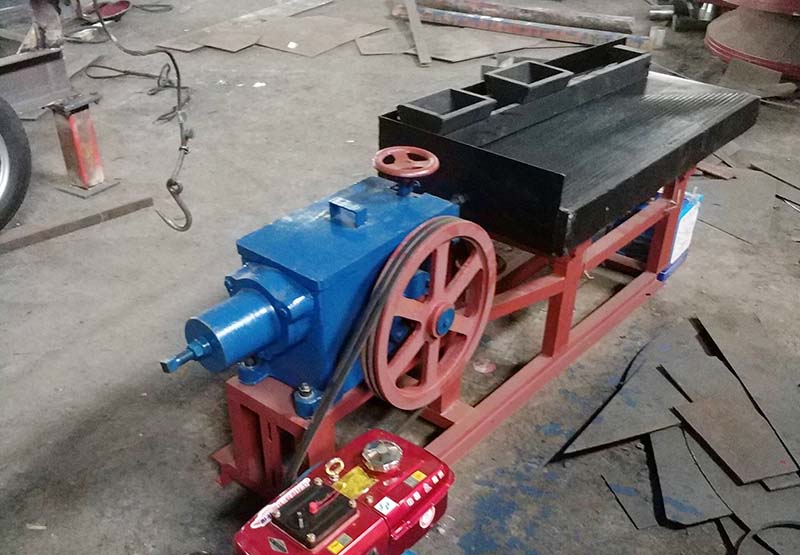
- Shaking tables
- Spiral concentrators
- Centrifugal concentrators
For example, in placer gold processing, a gravity test can determine whether coarse gold can be recovered by centrifugal concentration before additional processing, reducing costs and improving overall recovery.
3.2 Flotation Test and Equipment
Flotation is one of the most widely used beneficiation methods, especially for complex ores with fine valuable minerals.
The process depends on differences in mineral surface properties. During testing, engineers optimize flotation conditions to maximize concentrate quality and recovery.
Important flotation test parameters include:
- Grinding fineness
- Reagent type
- Collector dosage
- Frother dosage
- Pulp pH value
- Flotation time
Common flotation equipment includes:
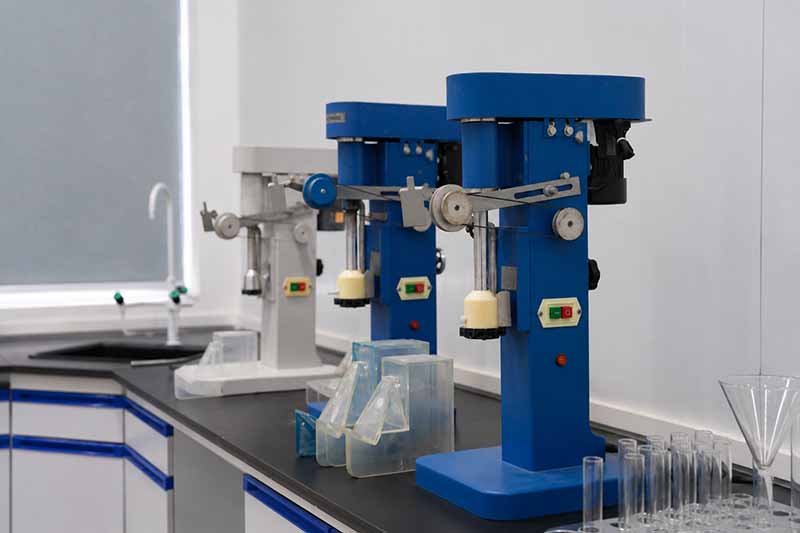
- Laboratory flotation machines
- Mechanical flotation cells
- Pneumatic flotation equipment
Flotation testing is especially important for:
- Copper ore
- Lead-zinc ore
- Sulfide gold ore
- Nickel ore
A properly designed flotation test can significantly improve recovery by identifying the best reagent system and operating conditions.
3.3 Magnetic Separation Test and Equipment
Magnetic separation is based on differences in magnetic properties between minerals.
It is commonly applied to:
- Magnetite iron ore
- Ilmenite
- Other magnetic minerals
Magnetic testing focuses on:
- Magnetic intensity selection
- Grinding size optimization
- Separation stages
- Concentrate quality
Common magnetic separation equipment includes:
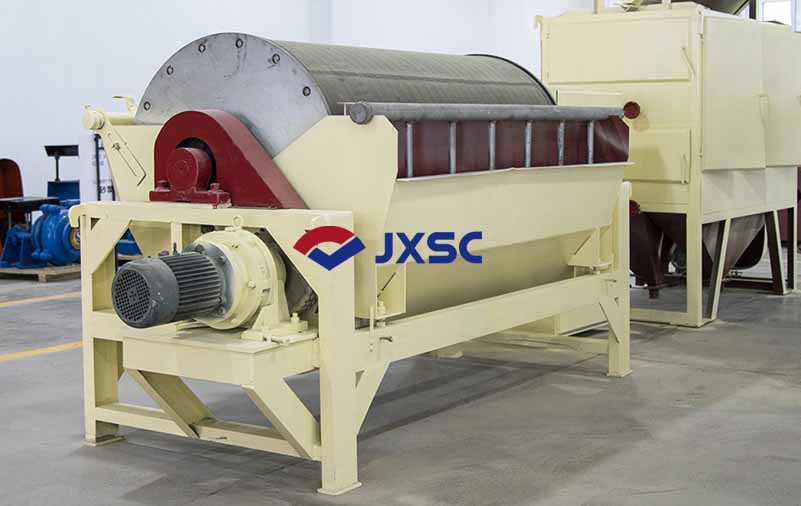
- Wet magnetic separators
- Dry magnetic separators
- High-intensity magnetic separators
For iron ore projects, magnetic testing helps determine whether low-grade ore can be upgraded into a commercial concentrate.
3.4 Combined Beneficiation Testing
Many complex ores cannot achieve high recovery through a single separation method. Combined beneficiation testing evaluates multiple processing routes.
Typical combinations include:
- Gravity separation + flotation
- Magnetic separation + flotation
- Gravity separation + magnetic separation
Combined tests are particularly important for polymetallic ores where several valuable minerals must be recovered separately.
How Beneficiation Test Results Guide Equipment Selection
A major advantage of mineral testing is that it connects laboratory results with industrial equipment decisions.
The relationship can be summarized as:
Ore Characteristics → Beneficiation Test → Process Design → Equipment Selection
For example:
- Gravity test results determine whether a jig, shaking table, or centrifugal concentrator is suitable.
- Flotation tests determine flotation machine type and reagent conditions.
- Magnetic tests determine magnetic separator specifications.
Beneficiation testing helps engineers define:
- Crushing and grinding requirements
- Processing capacity
- Equipment size
- Recovery expectations
- Operating costs
This prevents companies from purchasing equipment based only on assumptions.
Optimization Strategies After Beneficiation Testing
A successful beneficiation project requires continuous optimization, even after laboratory testing.
Key Optimization Areas Include:
Improving Recovery Rate
Strategies include:
- Adjusting grinding fineness
- Optimizing separation stages
- Reducing valuable mineral losses
- Reducing Processing Costs
Testing helps minimize:
- Energy consumption
- Reagent usage
- Equipment investment
- Improving Concentrate Quality
Optimization focuses on:
- Higher concentrate grade
- Lower impurity content
- Better market value
Pilot-scale testing is often recommended for large mining projects because it provides more realistic operating data before full-scale construction.
Practical Recommendations Before Starting a Beneficiation Test
Mining companies should prepare sufficient information before conducting testing.
Important preparation includes:
- Providing representative ore samples
- Sharing geological and mining information
- Defining target concentrate requirements
- Confirming expected production capacity
When selecting a testing laboratory, companies should evaluate:
- Testing experience with similar ores
- Available laboratory equipment
- Ability to conduct pilot-scale experiments
- Capability to provide complete process design
A reliable beneficiation test partner should not only provide laboratory data but also translate results into practical mineral processing solutions.
Conclusion
A Mineral Ore Beneficiation Test and equipment evaluation is one of the most important stages before constructing a mineral processing plant. It transforms uncertain ore characteristics into reliable engineering data and provides the foundation for efficient production.
Through systematic testing, mining companies can determine the optimal beneficiation process, select suitable equipment, improve recovery rates, and reduce investment risks.
From laboratory analysis to industrial operation, a well-designed beneficiation testing program ensures that every piece of equipment works according to the actual characteristics of the ore—creating a more efficient, economical, and sustainable mineral processing operation.
JXSC lab mineral processing equipment manufacturer has more than 38 years of experience in mining processing. We provide various lab mining equipment including gravity-separating equipment for processing minerals such as gold, tin, tungsten, lead, zinc, tantalum, niobium, iron, manganese, silver, titanium-iron, etc. Lab machines include laboratory jaw crusher, hammer crusher, roller crusher, grinding equipment, lab gravity separator, screening, washing equipment, etc. Welcome to consult!