I. Product Introduction:
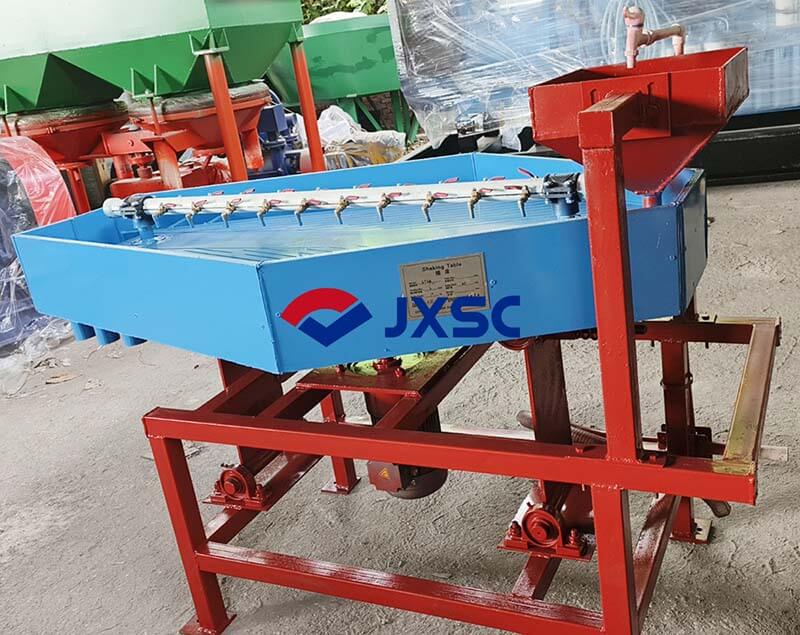
The Gemini shaking table is a gravity separation machine developed by our factory based on foreign designs. We have optimized three key components: the drive system, the shock absorption mechanism, and the swing amplitude mechanism. These improvements allow for the adjustment of the cradle panel’s swing amplitude without stopping the machine.
II. Application:
The Gemini Shaking Table is specifically designed for gold ore beneficiation; the recovered gold from the Gemini Shaking Table can be directly used for smelting.
III. Equipment Components:
- Support Frame: For the installation of all equipment components and fixation to the ground.
- Drive System: Geared motor, crank, and spring connection system.
- Anti-reverse system: Anti-reverse screws (rubber-tipped screws).
- Gold separation platform.
- Water supply pipe.
- Flushing water control valve.
- Centralized feeding system.
IV. Models and Specifications:
- Model GT-60: Processing Capacity: 30 kg/hour, Motor Power: 0.75 kW, Dimensions (L x W x H): 1650 x 950 x 1150 mm, Weight: 280 kg
- Model GT-250: Processing Capacity: 115 kg/hour, Motor Power: 1.1 kW, Dimensions (L x W x H): 2250 x 1350 x 1250 mm, Weight: 310 kg
- Model GT-1000: Processing Capacity: 0.5 tons/hour, Motor Power: 1.5 kW, Dimensions (L x W x H): 2800 x 1750 x 1350 mm, Weight: 340 kg
V. Equipment Operating Conditions:
- Power Supply: Standard voltage is 380V-50Hz. If other voltages are required, please specify them when ordering.
- Water Supply System: Recommended water pressure is 3 m or higher; the water source must be clean and free of impurities.
- Equipment Base: The equipment must be securely installed on a level and sturdy surface to prevent vibration during operation.
- Ore Feed Size: Less than 1.2 mm; a crusher can crush larger particles.
- It is recommended to remove all magnetic metal from the raw material with a magnet before feeding it onto the workbench.
VI. Equipment Installation:
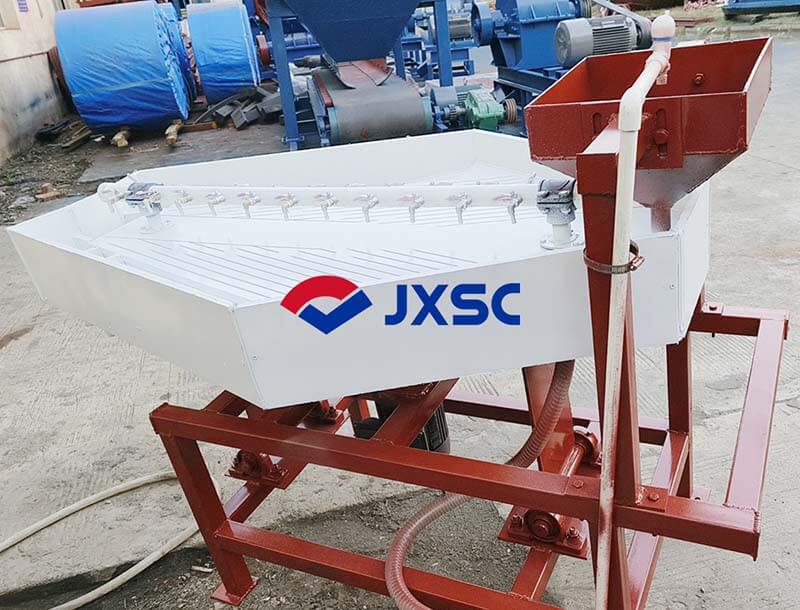
- Based on the equipment dimensions, pour concrete to create a horizontal surface and pre-drill holes for anchor bolts.
- Lift the equipment onto the reinforced foundation.
- Use a leveling instrument to ensure the worktable surface is horizontal; adjust the mineral processing surface of the worktable by wedge-shaped metal blocks to achieve complete horizontal alignment front-to-back and side-to-side. The tailings channels on both sides must be uniform in height, as this will prevent uneven distribution of minerals and water flow on the worktable, thereby affecting separation efficiency.
- After completing the above steps, securely fasten the frame to the ground.
- After completing Step 4, inspect the worktable again using the method described in Step 3.
VII. Equipment Commissioning:
- Rotate the anti-retraction screw (the rubber-tipped screw located below the concentrate outlet) away from the support plate.
- Adjust the two support plates to a vertical position by adjusting the front and rear spring seats.
- Power on the machine for a test run and observe whether a gap appears between the springs and the spring seats during the extension and retraction of the front and rear springs (you can also determine if there is a gap during operation by listening for any sounds, such as knocking, produced by the machine’s movement). To correct a gap between the springs and the spring seats: rotate the front and rear spring seats to increase the spring compression force, thereby eliminating the gap during movement.
- After completing Step 3, turn off the power. Adjust the anti-reverse screw to a distance of 5 mm from the support plate and securely fasten it with a nut.
- After completing Step 4, place a heavy object (such as a coin or nut) on the worktable, then power on the machine and observe the movement speed of the object on the worktable, which should be 5–10 mm/s.
- If the object moves too fast or too slow on the worktable, adjust the speed by rotating the spring seat connected to the reducer: turning clockwise slows the speed, while turning counterclockwise speeds it up.
- Once the above settings are complete, the machine’s power adjustment is finished.
- Flushing Water Settings: The flushing water settings are critical during the mineral processing operation of the Gemini shaking table.
- Set the main water valve to about half-open. Ensure that water is distributed across the entire worktable. Adjust the flow rate of each valve until a 2 cm water impact circle forms on the worktable.
- When the content of other ferrous metals is high or the particles are large, we need to modify the small valves: Measure the distance from the valve opening to the work surface, cut a piece of 8mm PE tubing to the same length (with one end flat and the other beveled), and insert the cut PE tubing into the valve, ensuring the beveled end faces the tailings chute. This modification controls the direction of the water flow and concentrates its impact force, ensuring that other ferrous metals and larger impurities are flushed into the tailings chute.
- Feeding Method: Place a screen (recommended: 1.5 mm mesh) inside the hopper and pour the ore onto the screen. Use flushing water to wash the ore from the screen onto the workbench. The purpose of this is to separate large-particle material, ensure uniform feeding, and prepare the slurry.
Follow the principles below during the gold separation process:
- High flow velocity: High recovery rate, low enrichment ratio.
- Slow flow velocity: Low recovery rate, high enrichment ratio.
- Low flushing water flow: High recovery rate, low enrichment ratio.
- High flushing water flow: Low recovery rate, high enrichment ratio.
Therefore, during operation, the relationship between the movement speed and the flushing water flow must be carefully balanced to achieve optimal results.
VIII. Equipment Maintenance:
Bearings:
Apply an appropriate amount of lubricating grease during daily production.
Gearbox:
We have selected a maintenance-free gearbox that is pre-filled with sufficient lubricating grease at the factory. However, after 10–12 months of operation, the gearbox must be disassembled to inspect the condition of its components and replace the grease.
Springs:
After a period of use, check if springs are damaged or deformed and replace them promptly.
Water Supply System:
The water source must be clean, fresh water. A filter must be installed at the inlet. If the machine is not used for a long period, drain all water from the pipes to prevent algae growth and blockage of the outlet.
Table surface:
The Table surface is the most critical component. During operation, do not expose the Table surface to high temperatures or intense ultraviolet (UV) radiation. Exposure to such conditions may cause irreversible damage to the Table surface (such as deformation or warping of the work surface, accelerated aging, and a shortened service life). Since the table surface is made of a wear-resistant material with poor paint adhesion, paint peeling may occur during use. This is normal and does not require repainting.
JXSC lab mineral processing equipment manufacturer has more than 38 years of experience in mining processing. We provide various lab mining equipment including gravity-separating equipment for processing minerals such as gold, tin, tungsten, lead, zinc, tantalum, niobium, iron, manganese, silver, titanium-iron, etc. Lab machines include laboratory jaw crusher, hammer crusher, roller crusher, grinding equipment, lab gravity separator, screening, washing equipment, etc. Welcome to consult!