Antimony is a strategic non-ferrous metal widely used in flame retardants, lead-acid batteries, semiconductor materials, alloys, and other high-value industries. However, with the continuous exploitation of high-grade deposits, many newly developed antimony resources have become more complex, lower-grade, and more difficult to process. Selecting an efficient beneficiation process is therefore critical for improving antimony recovery and reducing production costs.
An Antimony Ore Beneficiation Test and equipment selection process provides the scientific foundation for designing a successful processing plant. Instead of directly investing in large-scale equipment, mining companies can first analyze ore characteristics, test different separation methods, and optimize operating parameters through laboratory experiments. The results help determine the most suitable flowsheet, equipment configuration, and economic feasibility before industrial production.
A professional beneficiation test usually combines mineralogical analysis, gravity separation tests, flotation experiments, and process optimization. By connecting laboratory research with industrial plant design, companies can maximize antimony recovery while minimizing investment risks.
What Is an Antimony Ore Beneficiation Test?
An antimony ore beneficiation test is a series of laboratory and pilot-scale experiments designed to evaluate the recovery rate of antimony minerals from gangue minerals. The primary purpose is to understand ore behavior and develop an economical processing solution.
Unlike simple mineral testing, beneficiation tests focus on answering practical questions:
- Which beneficiation method provides the highest antimony recovery?
- What grinding fineness can achieve sufficient mineral liberation?
- Which flotation reagents provide the best selectivity?
- What equipment configuration is suitable for industrial production?
According to mineral processing experts, “The best beneficiation process is not determined by ore grade alone but by the relationship between mineral composition, liberation characteristics, and separation performance.”
Therefore, before selecting equipment such as crushers, grinding mills, jig separator, shaking tables, or flotation machines, a detailed beneficiation test is essential.
Antimony Ore Characterization
Before conducting separation experiments, engineers must understand the raw ore’s physical and chemical properties. Accurate ore characterization determines the direction of the entire beneficiation process.
Chemical Composition Analysis
Chemical analysis identifies the valuable and associated elements in the ore, including:
- Antimony (Sb) content
- Sulfur content
- Lead, zinc, copper, and gold content
- Gangue mineral components
This information helps determine whether the ore is a simple antimony deposit or a complex polymetallic ore requiring a combined recovery strategy.
For example, stibnite (Sb₂S₃)-dominated ores are generally suitable for flotation, while coarse-grained stibnite ores may achieve good results through gravity separation.
Mineralogical and Liberation Analysis
Mineralogy analysis is one of the most important stages of an antimony ore beneficiation test.
Modern testing methods include:
- X-ray diffraction (XRD)
- Scanning electron microscopy with energy dispersive spectroscopy (SEM-EDS)
- Optical microscopy
- Automated mineralogy analysis
These technologies help identify:
- Antimony mineral types
- Mineral distribution
- Grain size characteristics
- Relationship between antimony minerals and gangue minerals
The degree of liberation directly affects the choice of grinding and separation methods. If antimony minerals remain locked with waste minerals, even advanced flotation equipment cannot achieve high recovery.
Laboratory Antimony Ore Beneficiation Test Process
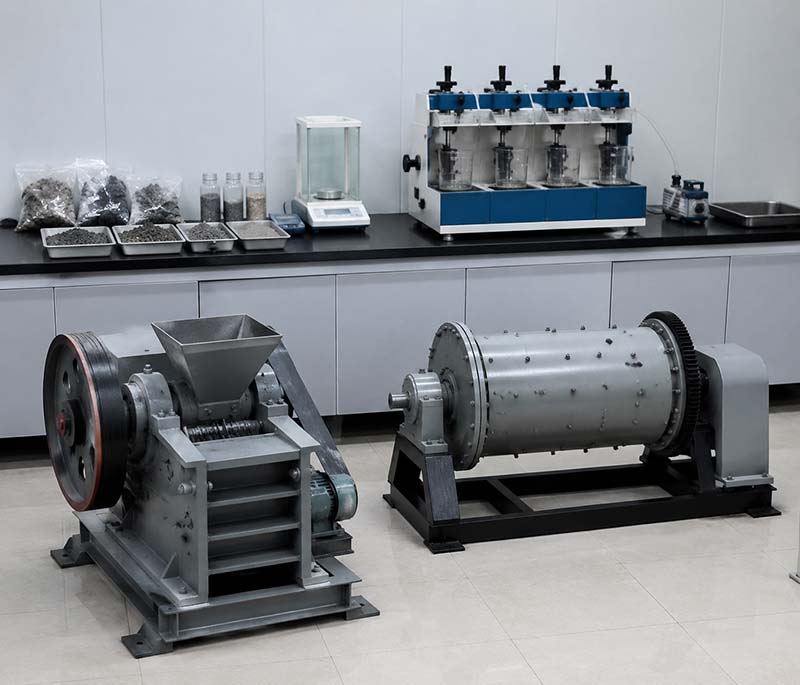
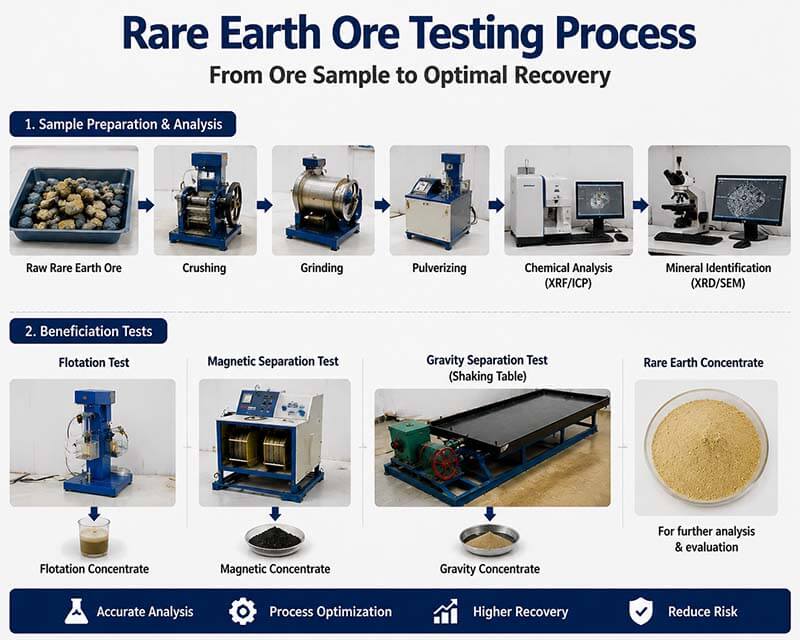
After ore characterization, laboratory tests are performed to determine the optimal beneficiation flowsheet.
Sample Preparation, Crushing, and Grinding
Representative samples are first prepared through:
- Sampling and mixing
- Laboratory crushing
- Grinding tests
- Particle size analysis
- Grinding is a critical step because sufficient liberation is required before separation.
However, excessive grinding should be avoided because it can:
- Increase energy consumption
- Produce excessive fine particles
- Reduce flotation selectivity
Laboratory grinding tests help determine the ideal particle size for maximum recovery.
Gravity Separation Test for Antimony Ore
Gravity separation is a traditional beneficiation method for antimony ore. It separates minerals based on density differences between antimony minerals and gangue.
Stibnite has a relatively high density compared with common waste minerals, making gravity concentration effective for coarse particles.
Common Gravity Separation Equipment
The main equipment used in antimony gravity tests includes:
- Jig concentrators
- Shaking tables
- Spiral concentrators
Among them:
Jig separators are suitable for recovering coarse-grained antimony minerals due to their strong processing capacity.
Shaking tables are suitable for fine particles and provide high separation accuracy.
Advantages of Gravity Separation
Gravity beneficiation offers several benefits:
- Low operating cost
- No chemical reagent consumption
- Simple operation
- Environmentally friendly process
However, gravity separation has limitations. Fine-grained antimony minerals are difficult to recover because their settling behavior is similar to gangue particles.
Therefore, gravity separation is often combined with flotation for complex ores.
Flotation Test for Antimony Ore Beneficiation
Flotation is the most widely used method for recovering fine-grained antimony minerals, especially stibnite.
The flotation process uses differences in mineral surface properties. After adding suitable reagents, antimony minerals attach to air bubbles and rise to the froth layer, forming concentrate.
Key Flotation Equipment
Laboratory and industrial flotation equipment includes:
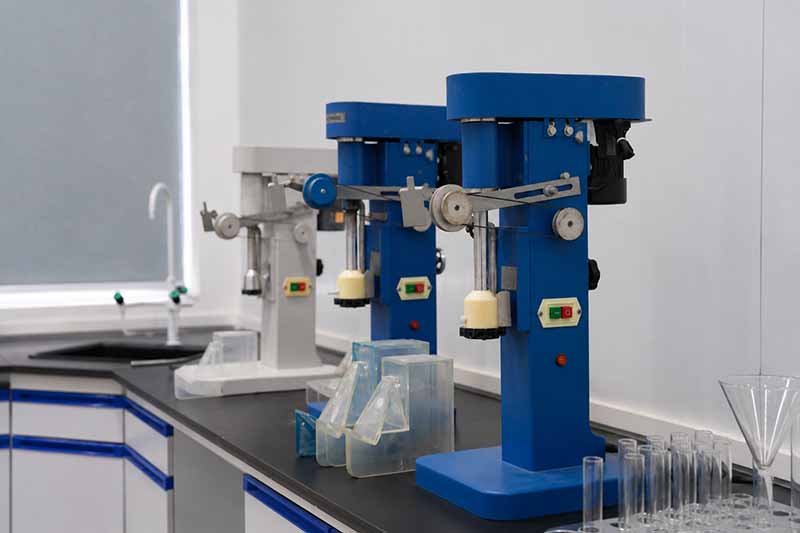
- XFD laboratory flotation machines
- Mechanical flotation cells
- Pneumatic flotation cells
The selection of flotation equipment depends on:
- Ore characteristics
- Processing capacity
- Required recovery rate
Flotation Reagent Optimization
Reagent selection is one of the most important parts of an antimony ore beneficiation test.
Common reagent categories include:
- Collectors, Collectors improve the hydrophobicity of antimony minerals.
Common examples:
- Xanthates
- Thiocarbamate collectors
- Activators
Activators improve mineral surface activity.
Examples:
- Copper sulfate
- Lead salts
- pH Regulators and Depressants
These control flotation selectivity.
Examples:
- Lime
- Sodium sulfide
During testing, engineers adjust reagent dosage to find the best balance between concentrate grade and recovery.
Laboratory Antimony Ore Beneficiation Test Process
A successful flotation test requires systematic optimization of operating conditions.
Important parameters include: Grinding Fineness
Determines:
- Mineral liberation degree
- Recovery efficiency
- Energy consumption
- Pulp pH
Influences:
- Mineral surface properties
- Collector performance
- Separation selectivity
- Reagent Dosage
Optimization involves testing:
- Collector dosage
- Activator dosage
- Frother dosage
Too much reagent may reduce concentrate quality, while insufficient dosage may lower recovery.
Flotation Time
Proper flotation time ensures maximum mineral recovery without unnecessarily increasing operating costs.
From Laboratory Test to Industrial Antimony Processing Plant
One of the biggest advantages of a professional beneficiation test is the connection between laboratory research and industrial production.
The typical development process includes:
Bench-Scale Testing
Purpose:
- Evaluate basic separation performance
- Select suitable beneficiation methods
- Optimize reagent systems
Pilot Testing
Purpose:
- Verify laboratory results
- Test continuous operation conditions
- Improve equipment parameters
Industrial Plant Design
The final test results determine:
- Crushing equipment selection
- Grinding circuit design
- Gravity separation equipment
- Flotation machine capacity
- Reagent system
This laboratory-to-industrial workflow reduces construction risks and improves plant performance.
Gravity Separation vs Flotation: How to Choose the Right Process
Factor | Gravity Separation | Flotation |
Suitable ore | Coarse-grained antimony ore | Fine-grained sulfide ore |
Equipment cost | Lower | Higher |
Reagent requirement | None | Required |
Recovery ability | Moderate | Higher |
Environmental impact | Low | Requires reagent management |
For many complex antimony deposits, a combined gravity-flotation process provides better results:
- Gravity separation recovers coarse particles.
- Flotation recovers fine particles.
- Overall recovery is improved.
Practical Recommendations for Successful Antimony Beneficiation
Based on beneficiation engineering experience, several principles should be followed:
- Conduct mineralogical analysis before selecting equipment.
- Avoid choosing equipment only based on ore grade.
- Optimize grinding conditions before flotation testing.
- Compare multiple reagent systems.
- Consider combined beneficiation methods for complex ores.
- Use laboratory results as the foundation for plant design.
Conclusion
Antimony Ore Beneficiation Testing and equipment selection are key steps in developing an efficient antimony processing plant. Through mineral analysis, gravity separation tests, flotation experiments, and parameter optimization, engineers can determine the most economical beneficiation strategy.
Gravity separation remains effective for coarse-grained antimony ores, while flotation provides better recovery for fine and complex deposits. In many modern operations, a combined gravity-flotation flowsheet offers the best balance between recovery, cost, and environmental performance.
By connecting laboratory testing with industrial plant design, mining companies can reduce investment risks, improve recovery rates, and build more efficient antimony beneficiation operations.
JXSC lab mineral processing equipment manufacturer has more than 38 years of experience in mining processing. We provide various lab mining equipment including gravity-separating equipment for processing minerals such as gold, tin, tungsten, lead, zinc, tantalum, niobium, iron, manganese, silver, titanium-iron, etc. Lab machines include laboratory jaw crusher, hammer crusher, roller crusher, grinding equipment, lab gravity separator, screening, washing equipment, etc. Welcome to consult!