I. Overview:
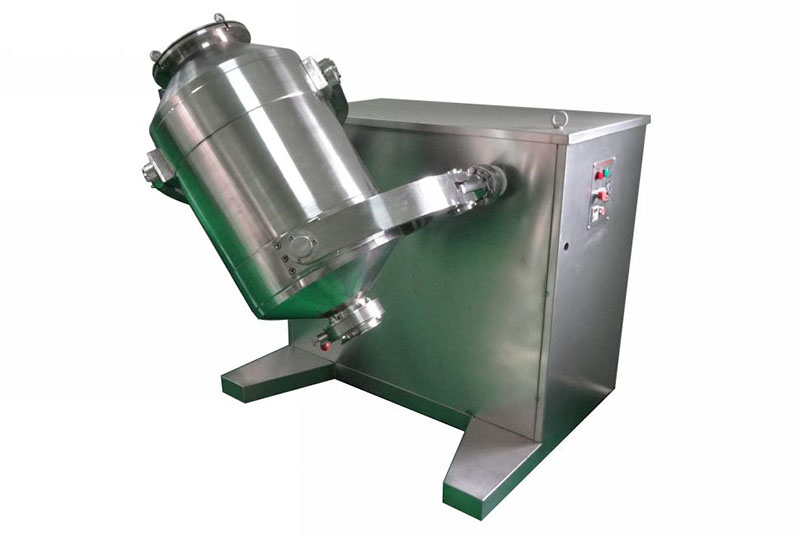
The series of high-efficiency three-dimensional motion mixers represents an upgrade over conventional mixers. By ensuring uniform mixing of materials, reducing mixing time, lowering energy consumption, ensuring product quality, and enhancing productivity, these machines deliver significant socio-economic benefits. It is one of lab equipment for lab testing.
II. Principle:
Unlike conventional mixers, which only perform simple “merge-separate, separate-merge” movements within the mixing drum during operation, resulting in low efficiency and poor quality, this machine operates differently. During operation, the mixing drum performs three-dimensional motion in the X, Y, and Z directions. While rotating on its own axis, it also rotates around a central axis. It creates intense turbulence within the drum, accelerating material diffusion, flow, and shearing. Simultaneously, the drum’s tumbling motion counteracts centrifugal forces, reduces density segregation, and ensures uniform mixing.
III. Structure:
This machine features mechanical transmission and electrical circuit control. The mixing section primarily consists of a drive shaft and a driven shaft, each equipped with a universal joint. A mixing drum is positioned between the two universal joints, and the two shafts connected to the universal joints intersect spatially and are perpendicular to each other, rotating around the drive shaft and driven shaft, respectively, via the universal joints. The movement of the mixing drum causes the materials to mix within the container.
The machine is made from stainless steel or carbon steel materials, or special materials for production, due to specific requirements imposed by mixed materials.
IV. Features:
- The mixing drum features three-dimensional motion in the X, Y, and Z directions, preventing material buildup during mixing. It ensures that materials of different specific gravities, densities, and states are mixed without the influence of centrifugal force or density bias.
- Mixing time is only 6–12 minutes per cycle;
- The mixing uniformity rate can reach 99.8% or higher;
- Low noise, low energy consumption, long service life, compact size, simple structure, and easy operation and maintenance;
- The mixing time can be optimized by adjusting the timer according to material requirements; in addition to mixing dry materials, the machine is equipped with a timed, metered liquid spraying, granulation, and drying system.
- The material loading capacity is 70% of the mixing drum’s volume, which is twice as easy to load as conventional mixers.
- Since the mixing drum is smooth and free of additional components, it is very convenient for changing product types or cleaning.
- To accommodate varying user requirements for mixing ratios or changes in product types (such as color), the machine’s mixing drum system can be configured with multiple removable mixing drums or multiple built-in mixing drums. This multi-purpose design saves costs, minimizes floor space, prevents cross-contamination of materials, and reduces labor and time, significantly enhancing economic efficiency. This capability is unmatched by any other mixing equipment.
V. Applications:
- Metal powders: powders made from metals such as aluminum, lead, zinc, copper, iron, nickel, alloys, and magnetic materials.
- Chemical materials such as resins, plastics, rubber additives, dyes, and fillers.
- Food products designed to meet hygiene standards: flour, cocoa, coffee, seasonings, additives, etc.
- Active pharmaceutical ingredients (APIs) for both Western and traditional Chinese medicine, as well as Western and traditional Chinese medicines, are designed in accordance with GMP standards.
- Grain processing: sorting, dehusking, and impurity removal of crops such as cereals, corn, legumes, and sesame.
- Abrasives: glass beads, aluminum oxide, corundum, carbon black, emery, quartz sand, and other grinding materials.
- Feed processing powders, pellets, additives, etc.
- Screening of fertilizer raw materials and fine screening of final products.
- Screening of various mineral ores and their processed final products by a lab vibrating screen.
- Fibrous materials: wood chips, wood flour, charcoal, activated carbon, carbon black, and other fibrous materials.
- Recycling and reuse of various materials and resources, including welding consumables, refractory materials, and phosphors.
VI. Schematic Diagram of the Mixing Drum’s Motion
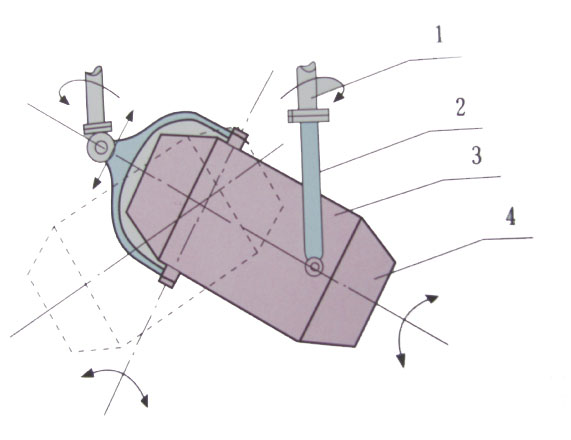
Icon: 1—Universal joint 2—Tilting wall 3—Mixing drum 4—Inlet and outlet
VII. Operating Instructions and Precautions:
- Before starting the machine, check that all fasteners on moving parts are secure and that the electrical wiring is in good condition.
- Do not stand near the mixing drum while the machine is running to avoid injury from impact.
- The maximum loading capacity of the mixing drum is 70% of its volume. After loading the mixture, secure the lid tightly to prevent loosening
- Depending on the mixing requirements of the material, adjust the mixing time on the digital timer before starting the machine. Generally, a mixing time of 6–12 minutes per cycle is recommended, except for special materials. Adjust the digital timer only when the power is disconnected; otherwise, the timer may be damaged.
- Before starting the machine, connect it to a three-phase, four-wire power supply. Ensure that the current and voltage meet the specifications listed on the nameplate of the electromagnetic speed-regulated motor.
- Perform regular and scheduled maintenance on the bearings and reducer in accordance with the requirements of the user manual.
VIII. Precautions:
The time relay used in this machine has a setting range of 0–99 minutes and 59 seconds. Time settings must be made while the relay is de-energized; otherwise, they will be invalid. To set the time, press the corresponding (+) or (-) button on the time relay panel.
If you hear unusual noises or detect electrical malfunctions during operation, immediately turn off the main power supply.
IX.Operating Procedures
(1) Before first use, please set the mixing time once.
(2) 380V wiring requirements: Three live wires labeled L1, L2, and L3, and a neutral wire labeled N. (For 220V, simply plug into a standard outlet.)
(3) After connecting the power, press the emergency stop button; the power indicator light will illuminate.
(4) Press the start button, then press the green button on the variable frequency drive (VFD) to start.
(5) Adjust the VFD to any frequency between 0 and 50 Hz.
(6) The machine will automatically shut down once it reaches the set time.
(7) After shutdown, press and hold the jog button; adjust to the optimal position and remove the material barrel.
Conclusion
Zircon beneficiation is a classic example of applied physical separation, but every deposit behaves differently. Without a systematic laboratory test—using gravity, magnetic, and electrostatic methods in sequence—you risk designing a plant that fails to achieve the target grade or recovery. For mining companies working with zircon-bearing heavy mineral sands, the message is clear: first characterize your ore, then run controlled lab tests with proper equipment, and finally scale up with confidence. Whether you are exploring a new beach sand project or troubleshooting an existing plant, the principles above will guide you to marketable zircon concentrate.
JXSC lab mineral processing equipment manufacturer has more than 38 years of experience in mining processing. We provide various lab mining equipment including gravity-separating equipment for processing minerals such as gold, tin, tungsten, lead, zinc, tantalum, niobium, iron, manganese, silver, titanium-iron, etc. Lab machines include laboratory jaw crusher, hammer crusher, roller crusher, grinding equipment, lab gravity separator, screening, washing equipment, etc. Welcome to consult!