Zircon is one of the most critical heavy minerals in the mining industry, yet it remains poorly understood outside geological circles. In simple terms, zircon is a zirconium silicate mineral (ZrSiO₄) that forms in igneous and metamorphic rocks. Over millions of years, natural weathering releases zircon grains from their host rocks. Because zircon is chemically inert and physically tough, it accumulates in beach sands, riverbeds, and coastal dunes as part of heavy mineral deposits. This durability, combined with its high specific gravity (4.6–4.7 g/cm³), makes zircon an ideal target for placer mining.
What Makes Zircon Industrially Important?
Zircon is the primary source of zirconium metal and zirconia (ZrO₂). Its key applications include:
- Ceramics: Zircon powder is an opacifier in glazes and tiles.
- Refractories: Their high melting point makes them ideal for foundry sands and furnace linings.
- Zirconium chemicals: Used in abrasives, pigments, and even nuclear fuel rods (due to low neutron absorption).
- Gemstones: Natural zircon is a semi-precious stone (not to be confused with cubic zirconia).
Because zircon often occurs alongside other heavy minerals such as ilmenite, rutile, leucoxene, and monazite, extracting it efficiently requires a well-designed beneficiation process. This blog explains the methods, laboratory testing procedures, and necessary equipment—focusing on practical insights for mining professionals.
What Is the Beneficiation Method for Zircon Ore?
Gravity pre-concentration:
Removes light gangue minerals by spiral chutes or shaking tables.
Magnetic separation:
Removes strongly magnetic minerals (magnetite, ilmenite, garnet) with low- or high-intensity magnetic separators.
Electrostatic separation:
Separates conductive minerals (rutile, ilmenite) from non-conductive zircon.
Final cleaning:
Using high-tension rolls or dry magnetic separation to achieve +95% zircon purity.
The most common commercial method
It combines wet gravity concentration (to produce a heavy mineral concentrate) followed by dry magnetic and electrostatic upgrading. For example, in Australian and African mineral sand operations, run-of-mine ore (typically 1–5% heavy minerals) is first processed through spiral concentrators to achieve a 90% heavy mineral concentrate. This wet concentrate is dried, then fed through rare-earth drum magnetic separators to remove iron-bearing minerals, and finally treated with electrostatic plate separators. The non-conductive, non-magnetic fraction is essentially pure zircon.
It is essential to note that no single method is effective for all deposits. Some zircon ores contain radioactive monazite, requiring additional gravity or flotation steps. Others have surface coatings (iron stains) that demand attrition scrubbing or acid leaching before final separation. Therefore, every ore body must take laboratory beneficiation tests before designing a full-scale plant.
How to Operate a Lab Zircon Beneficiation Test?
Running a reliable laboratory test for zircon ore is about simulating the industrial flow sheet at a smaller scale while maintaining statistical accuracy. The goal is to determine:
- The achievable zircon recovery and grade.
- The optimal separation parameters (splitter positions, drum speeds, voltage settings).
- The mass balance of products (zircon, by-product heavy minerals, and tailings).
Step-by-step procedure for Zircon testing laboratories.
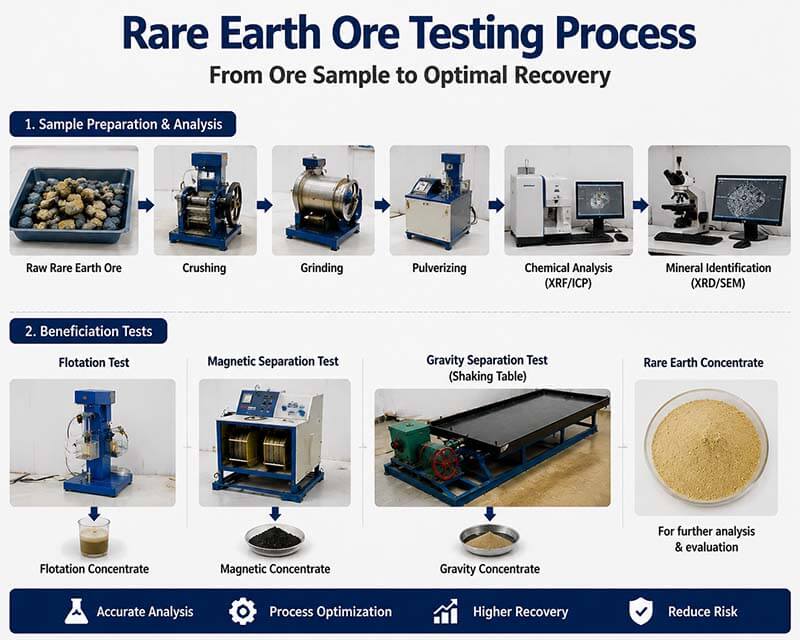
Step 1: Sample preparation
Obtain a representative sample (typically 20–50 kg for a standard test). Dry, screen, and split the material into subsamples. Perform a head assay to measure feed grade, size distribution, and heavy mineral composition.
Step 2: Gravity pre-concentration
If the feed is alluvial sand with <10% heavy minerals, run it through a laboratory-scale spiral concentrator or a shaking table. Collect the heavy concentrate and discard the light tails. Repeat passes if needed. Bullet points for gravity test setup:
Feed solids: 25–30% by weight.
- Table tilt: 2–5 degrees.
- Wash water rate: 3–8 L/min.
- Collect samples every 10 minutes for mass balance.
Step 3: Drying and desliming
The wet heavy concentrate must be dried at 105°C to remove moisture. If fine slimes (<38 µm) are present, use a dry air classifier to remove them, as slimes coat separator surfaces.
Step 4: Magnetic separation tests
Use a lab magnetic separator (e.g., Davis tube or Permroll). Start with low intensity (0.1–0.3 Tesla) to remove strongly magnetic minerals. Then increase to high intensity (0.8–1.2 Tesla) to remove weakly magnetic garnet and altered ilmenite. Record the non-magnetic fraction as “zircon + non-magnetic heavies.”
Step 5: Electrostatic separation
A lab roll-type electrostatic separator is essential. Key operating variables:
- Roll speed: 120–200 rpm.
- Electrode voltage: 20–35 kV.
- Electrode position: 1–3 cm from the roll surface.
Feed the non-magnetic product. Conductive minerals (rutile, ilmenite) will be attracted to the positive electrode and collected separately. Zircon, being non-conductive, drops off the roll into a product bin.
Step 6: Final cleaning and assay
The zircon product may still contain minor gangue. Re-run it through the electrostatic separator with adjusted voltage or use a final dry magnetic pass. Sample each product and analyze by XRF or QEMSCAN for ZrO₂ content. Acceptable lab concentrate grade is >65% ZrO₂ (equivalent to >90% zircon mineral).
Laboratory Equipment for Zircon Beneficiation Testing
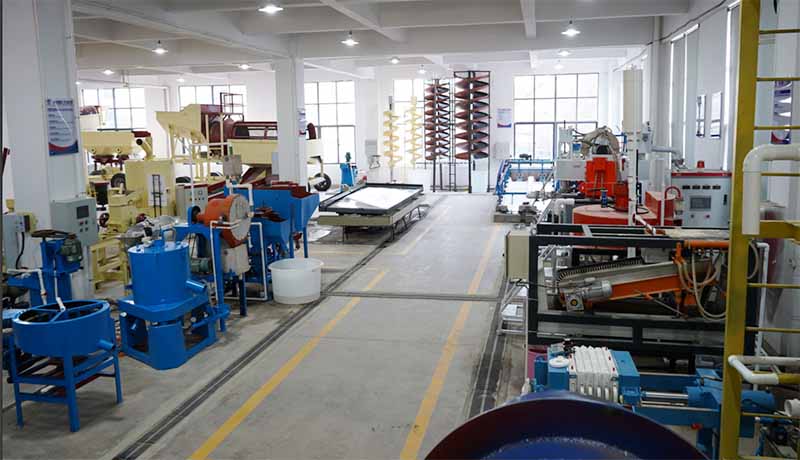
To perform the above tests effectively, your mineral processing laboratory requires a specific set of equipment. Investing in the right tools ensures repeatable results and scalable process design.
Essential equipment list by unit operation:
Sample preparation and sizing
- Drying oven (105°C, stainless steel interior).
- Sieve shaker and sieve set (from 38 µm to 2000 µm).
- Riffler sample splitter (8 or 12 slots).
- Pulverizer or disc mill for head assay samples.
Gravity separation
- Laboratory shaking table (ideally with variable tilt and stroke).
- Lab spiral concentrator (single or twin start, 2–3 turns).
- Mozley mineral separator (for fine heavies, 38–150 µm).
Magnetic separation
- Davis tube tester (for wet low-intensity magnetic separation).
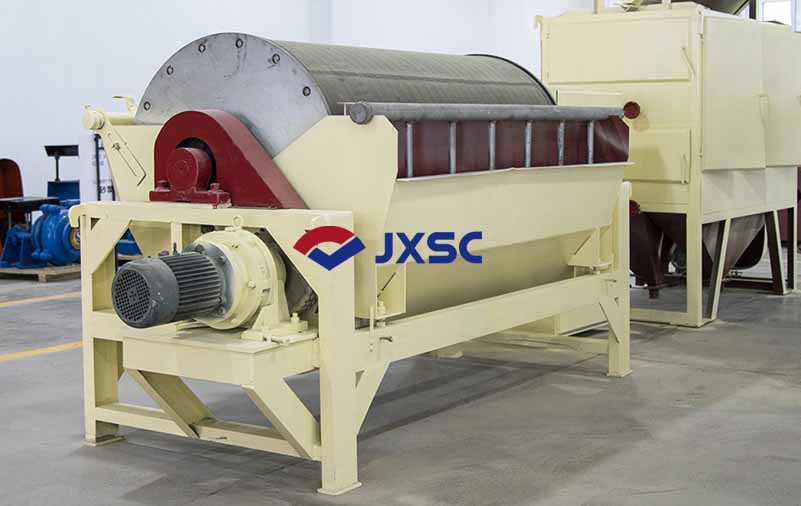
- Permroll magnetic separator (rare-earth drum, adjustable intensity up to 1.4 Tesla).
- Frantz isodynamic separator (for mineral fractionation in research).
Electrostatic separation
Lab roll-type electrostatic separator (e.g., Carpco or Outotec model) with variable voltage (0–40 kV DC) and roll speed control.
Important: Must include electrode heating (to remove moisture from mineral surfaces).
Assay and mineralogy
- X-ray fluorescence XRF spectrometer for rapid ZrO₂ analysis.
- Optical microscope or automated mineralogy (QEMSCAN, MLA) for grain counting and liberation analysis.
- Pycnometer or specific gravity bench for density checks.
Auxiliary tools
- Digital balance (0.01 g precision).
- pH and conductivity meter (acid leaching).
- Vibratory feeder for dry separation steps.
Conclusion
Zircon beneficiation is a classic example of applied physical separation, but every deposit behaves differently. Without a systematic laboratory test—using gravity, magnetic, and electrostatic methods in sequence—you risk designing a plant that fails to achieve the target grade or recovery. For mining companies working with zircon-bearing heavy mineral sands, the message is clear: first characterize your ore, then run controlled lab tests with proper equipment, and finally scale up with confidence. Whether you are exploring a new beach sand project or troubleshooting an existing plant, the principles above will guide you to marketable zircon concentrate.
JXSC lab mineral processing equipment manufacturer has more than 38 years of experience in mining processing. We provide various lab mining equipment including gravity-separating equipment for processing minerals such as gold, tin, tungsten, lead, zinc, tantalum, niobium, iron, manganese, silver, titanium-iron, etc. Lab machines include laboratory jaw crusher, hammer crusher, roller crusher, grinding equipment, lab gravity separator, screening, washing equipment, etc. Welcome to consult!